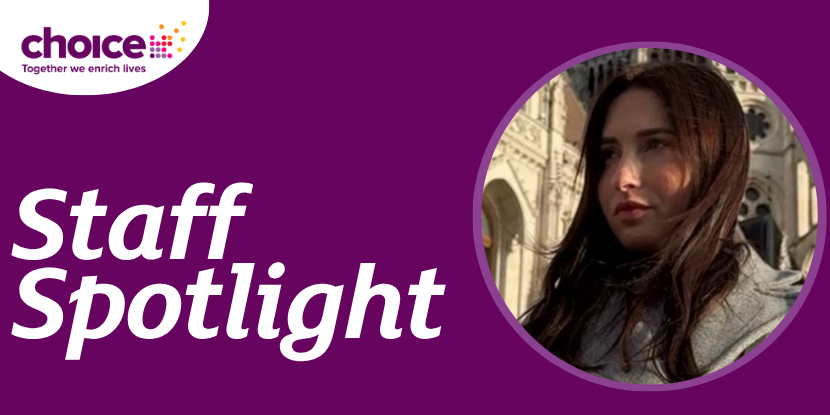
Maryna Dudnichenko
Maryna Dudnichenko works in the Development Department as Development Assistant. Originally from Kyiv, Ukraine, Maryna arrived in Northern Ireland in May 2022 with her daughter under the UK’s humanitarian relocation scheme. Now part of the team helping to support the development of new homes and communities, she shares her story of leaving home, building a new life, and looking ahead with hope.
My life in Kyiv was absolutely ordinary, probably not much different from your life here. I had my own plans — short-term and long-term. We planned things for today, for tomorrow. Where we would spend the holidays, where my daughter would go to study in two years’ time. And then, in one moment, all of those plans collapsed — because the war started.
I have to say that almost none of us believed it would ever happen. We live in a civilised world. Yes, there had already been a war since 2013, but suddenly it escalated into something much more aggressive. Honestly, it doesn’t even feel like a war — it feels like terrorism. Maternity hospitals, kindergartens, civilian buildings, ordinary people — these are being targeted every day. So we were completely unprepared.
Many of us became what I can only call forced emigrants — although even that word doesn’t feel completely right. Emigrants plan their move. They learn the language, save money, build a strategy. We had none of that.
We just grabbed the most essential things — documents, money, a change of clothes, a spare pair of shoes. The bare minimum. At first, I went to friends outside the city with my daughter. It seemed a bit calmer there, but it quickly became clear that it was dangerous everywhere. Constant shelling, reports of military convoys moving, planes and helicopters flying overhead — and we didn’t even know whose they were.
After a few days we returned home, because it didn’t make sense to stay — it was dangerous everywhere anyway. About a month later, I read that the United Kingdom had announced a humanitarian protection programme. I had some foundation in English, and my daughter spoke very well, so I understood we wouldn’t face as strong a language barrier as we might elsewhere.
The programme worked on the basis that British people opened their homes to us, offering shelter and support while we settled. We were very lucky — we found a wonderful family who welcomed us in. They became like second parents to us, and we are still very close.
We arrived in May 2022. It was still very hard. We missed — and still miss — home terribly, especially at the beginning. Our own beds, our own things, our normal life.
And the food! We miss our food a lot. Even when you find something similar in Polish or Lithuanian shops, it’s still slightly different. We also miss the sun. In Ukraine, even winter days are often sunny. Summers are hot — sometimes too hot — but now I would happily accept just a few really warm days a year.
Of course, we also miss our family. It’s just me and my daughter here — everyone else stayed in Ukraine. My grandmother is very elderly, and my mother stayed to take care of her. Travelling home now takes almost two full days, but we still visit when we can, at least once a year.
People often ask me if there are really bombings there. Yes. Even over my own neighbourhood I have seen missiles and drones being shot down. There are constant explosions and air-raid alerts — sometimes lasting more than 30 hours. In theory, you should go to shelters, but in reality, you would have to live underground. So people continue living their lives as normally as possible, with a constant level of risk.
Even knowing that, I cannot imagine not visiting home.
When I first came to Northern Ireland, my first impression was that it was very cold and very wet — and it welcomed us with rain!
I remember it clearly. Back in Ukraine, mid-May is already real summer — T-shirts and shorts. But here it was cold and raining.
The funny thing is that we brought two suitcases full of summer clothes — the kind you would take on holiday to Spain. I hadn’t really checked the weather. My mind probably wasn’t working very clearly at that time.
Even now, I still haven’t fully adjusted. Summers here still feel quite cold to me — you will rarely see me wearing short sleeves.
But the people were incredibly warm, kind and big-hearted. There was a real sense of support, and that was very touching.
Another surprise was the houses — no air conditioning. At first I thought, “How will we survive the summer?” In Ukraine, it’s almost impossible without it. Later I realised — you simply don’t need it here.
Kyiv is a city of around three million people, with many high-rise apartment blocks — sometimes 20, 30, even 35 floors. Here everything felt very small and quiet. At first, it almost felt a little post-apocalyptic — very few people on the streets. Now I understand it’s actually quite busy, but at that time it felt very empty.
I would like people to know that Ukrainians are a very hardworking nation. Sometimes I hear comments that immigrants are “tax eaters.” But government statistics published last summer showed that Ukrainians, together with Afghans, account for just 0.7% of benefit recipients.
There are also many interesting things people might not know about Ukraine.
For example, Ukraine built the largest and heaviest aircraft ever — the Antonov An-225 Mriya. It had a 290-foot wingspan, six engines, and could carry around 250 tons. It was destroyed in 2022, but there are plans that a second unfinished version may still be completed.
Ukraine is also a space-industry country. After the collapse of the Soviet Union, it inherited a large part of the aerospace sector and continues to contribute to international space projects.
We are also very advanced in digital government services. Most documents are available through an app called Diia, where your phone can legally replace your passport or driving licence. You can even register a business online in about 10 minutes.
Speaking about my professional journey here, I am very grateful for the trust I was given. My background is in banking, where I worked in several roles but I believe I have transferable skills, and I learn quickly.
This is not my first job here. I started working just one month after arriving, while still working remotely for a Ukrainian bank. At that time, I worked in a factory, organising orders and ensuring workflows ran smoothly. It wasn’t my dream job and didn’t offer much development.
At Choice, it feels different — I feel welcomed.
To be honest, I have stopped making long-term plans. The first time was during COVID, and after the war started, I almost completely stopped planning.
Even now, life still feels a bit temporary. I don’t feel fully settled, and sometimes it feels like everything could suddenly change again. Because of that, I sometimes hold back my ambitions.
Right now, my main hope is simply that the war will end.
It’s difficult to fully enjoy life when you know your family is not safe. Every morning I wake up and check the news to see if there were attacks overnight. Living with that constant worry is very hard.
What I would really like is simply to know that everything is safe at home. Only then would it be possible to truly relax and enjoy life.
For now, I am just grateful for what I have. And I don’t even have clear plans for this summer yet — except for one thing: we would really like to visit home.
Maryna’s story is a powerful reminder of resilience, courage and the importance of community. We are proud to have her as part of the Choice team.